


The speed of business changes today necessitates competitiveness through relentless people development in terms of skills and competency. Partnering with corporate training companies brings a number of advantages to enable the organization to soar to new heights. The top 10 advantages are listed below where corporate training companies engage with your organization.
1. Customized Training Programs
One important advantage of working with corporate training companies is the possibility of getting adapted training programs. Such firms listen to and take up the specific needs of your enterprise to adapt the modules of training to an area that reflects some exact problem in your enterprise. Therefore, it makes the training highly relevant and immediately applicable.
2. Expertise and Industry Knowledge
Corporate training companies boast a great pool of know-how and industry understanding. They are also rich in experienced, qualified trainers, often professionals in their field. That means your employees will be assured the highest quality of training possible, enabling them to put whatever they learn into practical use in their field. It also guarantees that the training your employees get is relevant at present under current industry standards.
3. Improved Employee Performance
Investing in training through corporate training companies greatly improves the performance of your employees: a well-trained employee is surer of himself, more productive in the performance of tasks set before him, and better equipped to rise up to challenges. This will directly reflect in increased productivity and better results on your organization’s balance sheet.
4. Increased Employee Engagement
The continuous learning and development by corporate training companies will definitely enhance the motivation and commitment of your employees. For such employees, the probability of being retained within the organization is high, which means lower turnover rates and a rather loyal workforce.
5. Cost-Effective Solutions
While creating an in-house training program may be expensive and time-consuming, corporate training companies provide a very economical alternative. Outsourcing will provide your company with quality programs while avoiding the overhead needed to develop and maintain the programs in-house.
6. Scalability and Flexibility
With corporate training companies, scalable solutions can be offered to grow with your organization. Whether one needs to train a small team or a whole department, the corporate training company will scale its programs to suit your organization’s needs. Secondly, it gives way to flexibility in delivery – online, in-person, or hybrid – depending on learning preference.
7. Core Business Functions
To this end, an organization partnering with corporate training companies that will take care of employee training and development professionally will have more time to focus on its core business activities. The critical management time, therefore, can be freed for work on business strategy rather than the training issues.
8. Access to the Latest Training Technologies
Corporate training companies are usually the first ones to adopt any new training technologies. This is another reason partnering with them will be important, as by investing in state-of-the-art tools and platforms, they can construct an effective and engaging training experience. The latest cutting-edge technologies for which your organization will be supported include virtual reality, gamification, and AI-driven learning modules.
9. Better Compliance and Risk Management
Many industries require employees to update themselves with regulations and standards in general. Companies offering corporate training will make sure that your workforce is compliant with the latest industry requirements, reducing all possibilities of legal issues and enhancing overall safety within the organization.
10. Measurable Results and ROI
Last but not least, corporate training companies can provide quantifiable results to understand the contribution of training to an organization. They use metrics and assessments that show, in great detail, the effectiveness of the training programs. This fully provides insight into the ROI and aids informed decisions on training initiatives in the future.
Conclusion
The many advantages availed by partnering with corporate training companies create a wide variety of strategic options for your organization—from designed training programs to measurable results. Partnering with corporate training companies helps establish a competitive advantage that is an essential part of being in business today. By investing in professional training, you empower your employees to excel, which means the growth and prosperity of your organization.
Empower your people. Strengthen your business. Start your corporate training journey with TransforMe who understand your goals.

Revolutionizing Employee Development: How Corporate Training Companies Are Leading the Charge
Employee development is one of the key building blocks to drive growth and success in an organization. Corporate training proves to be a major enabler in unleashing the powers of individuals towards creating pathways for business outcomes. When employees succeed, the company does too. In this blog, we will find out how corporate training companies are embracing advanced technologies and strategies to drive organizational success.
The Evolution of Corporate Training
Until recently, corporate training was performed using some of the most traditional and obsolete methods, which didn’t fit the bill anymore as the nature of the workforce changed so rapidly. But then came corporate training firms, changing this scenario by introducing new technologies and methodologies to enhance productivity at workplaces. The newer breed of workforce absorbs this kind of learning and finds it quite appealing, thus making learning a more dynamic and effective process.
Leverage Technology for Better Learning
Training companies have a reputation for doing things differently, mainly by integrating technology in ways that make learning not only fun but productive. Ditching those retro methods means embracing digital tools that keep training fresh, relevant, and current with the demands of the workplace.
E-Learning Platforms
E-learning platforms revolutionized the training world by providing flexible and accessible learning opportunities. The employees may participate in training sessions whenever they find it convenient, and hence can balance professional development with other priorities. Corporate training companies ensure learning is accessible, effective, and adaptable to various needs.
Virtual Reality and Augmented Reality
VR and AR are going to revolutionize training by simulating scenarios that are real. The company offering corporate training makes use of VR in developing case simulations in handling high-tech equipment in immersive learning. AR does just the same by overlaying useful digital information on the real world in real-time. The technologies provide a safe environment that is non-threatening and allows learners to pick up confidence in their competence.
Personalized Learning Experiences
One of the significant paradigm shifts in corporate training has to do with moving toward personalized learning experiences. The traditional ways of training lacked this particular aspect of customization. However, modern corporate training does exceptionally well, considering state-of-the-art technologies down to artificial intelligence in customizing programs per the needs and specifications of an employee or the organization.
Data Analytics
Analytics of data would, therefore, help corporate training companies to identify gaps in skills and learning preferences. Further, performance data analysis enables them to create training programs which exactly meet unique organizational needs, hence effective and pointed learning experiences.
Artificial Intelligence
AI will play an important role in personalizing training content. AI-enabled platforms continuously readjust themselves based on the progress recorded by an employee and provide them with a more engaging learning space. In such a case, not only do the trainees tend to get more but also effective engagement, hence ensuring the training need within the entity is actually met.
Creating a Continuous Improvement Culture
Corporate training companies don’t just stop at single training but rather create the concept of continuous learning. This kind of approach realizes that employee development is a long-term process without which success cannot be achieved.
Microlearning
Microlearning involves breaking down content into small, digestible chunks so that employees do not experience information overload. Corporate training companies apply this methodology in their practice by providing short and concise lessons that can be fit into busy schedules, thus making the development of skills more accessible and convenient.
Feedback and Support Continuously
Coupled with timely feedback, ongoing support helps in ensuring that people actually learn something worthwhile. Corporate training firms ensure mechanisms are put in place through which frequent feedback is provided to employees, which helps them in honing their skills and applying them to situations at work.
Measuring the Effectiveness of Training
Most corporate training firms understand the importance of measuring training effectiveness. Today, most make use of advanced analytics and feedback mechanisms for measuring the effectiveness of any particular training. KPIs
KPIs can help corporate training companies track manifold aspects of effectiveness in training, such as increase in the performance of employees, rate of skill acquisitions, and return on investment. These metrics provide insight into the value of results produced from the training programs.
Feedback Mechanisms
Employee feedback about training is important in order to know whether such training works. Surveys, assessments, and focus groups may provide insight into what the experience was like and how it challenged or promoted workforce development. Corporate training firms use such feedback in constantly updating and revising their programs.
Conclusion
They are companies that lead the charge in changing professional development. Applying advanced technologies, creating personalized learning experiences, and fostering a culture of continuous improvement-the way employees learn and apply new skills changes. With business continuing to evolve, corporate training will be not only about shaping the future of employee development but also contributing significantly to organizational success and growth.
Employee development is an essential component for the growth of any company. Corporate training plays a significant role by introducing new innovative ideas that bring out the best possible potential of an individual, and help in making a growth pathway for the business. An employee’s success is the company’s success so this exclusive training provides an idealistic workplace to businesses. This blog emphasizes how corporate training companies integrate advanced technologies and strategies to thrive companies.
The Evolution of Corporate Training Companies
The approach to corporate training was traditional and outdated by indulging the last age methods rather than innovating or introducing something significant. These corporate training companies arrived that took the whole limelight and became the best choice to improve the company’s success rate with the new edge technology and methodology and bring productivity in the workplace. These methods and ways get along with the new-gen employees and enhance the productivity of the overall company or organization.
Embracing Technology for Enhanced Learning of Corporate Training Companies
Corporate training is publicized for its unique approach and use. Leaving out the old methods and adopting the new technology, these training methods resonate with today’s employees, resulting in the success of the company and embracing these technologies for the longer run. To deliver the learnings digital tools are used like online Platforms, VR, and CR to enhance the experience and increase excitement to learn.
- E-Learning Platforms – E-learning mediums have extensively changed the learning dynamics of training offering flexibility with ease and accessibility from anywhere. Employees can participate in training whenever they feel like regulating their lives with other obligations. These corporate trainings make sure to provide accessible learning.
- Virtual Reality (VR) and Augmented Reality (AR) – VR and AR are advancing training by replicating real-world scenarios. Corporate training companies use VR to imitate high-tech equipment handling and AR to impose helpful digital information in real-time. These technologies provide an engaging experience in a balanced environment, learning, and confidence.
Personalized Learning Experiences of Corporate Training Companies
The change towards personalized learning is another observable change driven by corporate training companies. Traditional training methods fail in customization, but modern corporate training is excelling using high technology and artificial intelligence (AI) to meet the expectations of training programs for the companies.
- Data Analytics – Data analytics helps corporate training companies to spot specific skills and learning preferences. By calculating performance data, these companies are specially made to point out those issues along with their solutions for training programs that meet the company’s unique needs, giving assurance of effective learning experiences.
- Artificial Intelligence (AI) – AI plays a crucial role in personalizing training. AI-driven mediums adapt the content in real time based on employee progress and execution. Corporate training uses AI to create engaging learning environments that cater to company needs enhancing engagement and effectiveness.
Fostering a Culture of Continuous Learning in corporate training companies
Corporate training companies also focus on fostering a culture of uninterrupted learning rather than just delivering one-time training sessions. This approach acknowledges that employee development is an enduring process.
- Microlearning – Microlearning provides content in small, controllable segments, permitting employees to study without feeling daunted. Corporate training uses this strategy to supply fast, concentrated lessons that fit into a heavy workload, making skill-building more convenient.
- Continuous Feedback and Support- Recent responses and assistance are impactful for valuable learning. Corporate training companies implement systems that give routine feedback and learning, assisting employees diligently, and refining and executing their skills in real-world situations.
Measuring Training Effectiveness of Corporate Training Companies
Taking a look at the outcome of training programs is a priority for corporate training. Advanced analytics and feedback mechanisms are now used to measure the success of training initiatives.
- Key Performance Indicators (KPIs) – KPIs help corporate training companies monitor various attributes of training efficacy, such as enhancements in employee achievement, skill acquisition rates, and return on equity(ROE). These measurements offer invaluable vision into the outcome of training programs.
- Feedback Mechanisms – Employee response is critical for evaluating training potency. polling, analysis, and focus groups provide perspective into the teaching expertise and its influence on workforce development. Corporate training programs use this reaction to improve and strengthen their programs.
Conclusion
Corporate training companies are at the cutting edge of pioneering professionals. These companies are revolutionizing how employees attain and use new skills through advanced technologies, customized learning experiences, and a concentration on continuous development. As the business world continues to grow, the role of corporate training in forming the future of employee development will become increasingly important, driving organizational success and growth.
Empower your people. Elevate your performance. Let’s build a corporate training strategy that turns potential into performance.
Notably, getting team transformation and the people to work as a perfectly aligned team can indeed be very difficult. However, it is essential for the successful running of any organization. Such problems can be resolved and a cohesive, high-performance team created by implementing a structured team alignment program.
Indicators of Aligned vs. Misaligned Teams
An effective team alignment program could make a huge difference in organizational performance for achieving team transformation. This section highlights some key indicators of how one will distinguish between an aligned and misaligned team.
Aligned Teams
- Common Vision and Goals
- The team members are quite aware of the vision and goals of the organisation and are committed.
- Well-articulated objectives and widely accepted which gives way to synchronised work
- Better Communication
- Open, transparent, and frequent communication exists in the team.
- Feeling comfortable sharing ideas and feedback
- High Levels of Trust
- Feeling the team members have trust in each other and in the leadership.
- Functioning in Visitation and reliability, thereby increasing the bond between themselves
- Collaborative Culture
- Team members display a very strong level of teamwork and mutual support.
- Team members are able to work well together, drawing on each other’s strengths.
- Well-Defined Roles and Responsibilities
- Everybody is clear about what his or her role and responsibilities are.
- Role clarity brings down confusion and overlaps, hence improving efficiency.
- Uniform Performance and Results
- The team regularly delivers results and attains performance objectives and goals set out for them.
- There is a strong orientation toward collective results with continuous improvement.
- Psychological Safety
- The environment is secure and free from reprisal, with the team member having the freedom to express his or her opinions and share concerns.
- Creativity and innovation are fostered in an enabling environment.
- Constructive Conflict Management
- The conflicts are resolved quickly and constructively.
- Multi-dimensional thinking and discord bring good decision-making.
- Engagement and Motivation
- The team members are very well-engaged and motivated.
- There is a sense of purpose and job satisfaction.
- Adaptability and Resilience
- The group is flexible and able to change quickly.
- Challenges are positively met and approached.
Misaligned Teams
- Lack of Common Vision
- Different or vague ideas among team members on the vision and mission of the organization.
- Mismatched objectives result in fragmented efforts.
- Poor Communication
- Communication is infrequent, unclear, or ineffective.
- There is a reluctance to share information or feedback.
- Low Levels of Trust
- Lack of trust in fellow team members and the leader.
- High degree of skepticism; there is a reluctance to rely on others.
- Isolated Work Culture
- Team members work in isolation and not as a team.
- There is little to no cross-functional cooperation.
- Roles and Responsibilities Unclear
- The roles and responsibilities are undefined or ill-defined.
- In such a situation, there is confusion leading to overlap, inefficiency, and missing deadlines.
- Inconsistent Performance and Results
- This team does not meet its performance targets and goals consistently.
- There is no focus on collective results and improvement in terms of this aspect.
- Lack of Psychological Safety
- Team members do not feel safe to express ideas or their concerns.
- There is the fear of retribution that kills innovation and creativity.
- Destructive Conflict Management
- Conflicts are ignored or poorly managed.
- Unresolved conflicts lead to tension and disturbed team dynamics.
- Low Engagement and Motivation
- The team members are disengaged and demotivated.
- There is an observable lack of purpose and job satisfaction.
- Inflexibility and Rigidity
- The team resists change and is slow to adapt to situations.
- Challenges are resisted and responded to negatively.
On the lookout for a great team alignment training program: This would help in molding a cohesive, high-performance team. An effective design in a team transformation and alignment program is one of the most influential factors in achieving greater collaboration, trust, and increased productivity. Ten such proven ways to enhance team alignment in your organization are discussed in this blog.
Proven Way 1 – Alignment of Values for Team Transformation
Allow your fellow members to share and communicate the core values of an organisation. This is the step to help transform your team; all basic ingredients behind any successful program are for the alignment of a team.
Proven Way 2 – Focus on Collective Results
Drawn from Patrick Lencioni’s model of “5 Dysfunctions of a Team,” focusing on collective results against individual achievements, this mindset also entails an atmosphere of accountability. It is team transformation in action, propelling towards linking the individual goals and outcomes with the outcomes of the team alignment program.
Proven Way 3 – Inclusion in Action- Focus on Inclusion of Diverse Thoughts, Fairness, and Creating a Culture of Belongingness
Bring in diverse thoughts and foster a culture of equity and belongingness. This promise of inclusion shall be inherent within a successful team alignment program for driving changes in the overall team.
Proven Way 4: Role Clarity and Setting Clear Goals within the Team Alignment Program
Define clear roles and set specific goals for the members of the teams. Be clear about the shared vision and strategic vision of the organisation—this lays the bedrock for any effective team alignment program aimed at team transformation.
Proven Way 5 – Effective Communication in Team Transformation (Dialogue, Two-Way, with Clarity on Intent)
Foster open dialogue and two-way communication with a clear understanding of the intent. This would help in building an effective component of team transformation, which enhances the effectiveness of your team alignment program.
Proven Way 6: Psychological Safety in the Team Alignment Program—Creating a Safe Space for Conversations and Speaking Up
Create a safe space for conversations and encourage the team members to speak up. Psychological safety is what is most important for a team alignment program and is at the heart of the whole process of team transformation.
Proven Way 7 – Trust in Team Transformation (Vulnerability, Sharing, Competence, Loyalty, Delivery – What Do You Trust Each Other For)
Build trust in the team through vulnerability, sharing, competence, loyalty, and reliable delivery. The very core of any team alignment program is trust, which has to happen if the team wants to transform.
Proven Way 8: Healthy Conflict.
Using Patrick Lencioni’s model of the “5 Dysfunctions of a Team” encourages healthy conflict to surface different perspectives for better decision-making. This supports the work of team transformation and strengthens the program on team alignment.
Proven Way 9 – Building Synergy and Collaboration within the Team Alignment Program
Begin building synergy and encourage collaboration amongst team members. These are the essential elements for the success of the team alignment program and drivers of team transformation.
Proven Way 10: Leveraging Strengths in Team Transformation
Identify and leverage the unique strengths of each member. Just this one strategy of utilising individual strengths effectively is powerful within a team alignment program and makes immense contributions toward team transformation.
See how TransforMe’s “team alignment program” can transform your organisation. Our battle-tested strategies and techniques have assisted many organisations in their pathway to success, simply by bringing about better alignment of the team. Discover how you can leverage these tailored solutions to take your team’s performance to the next level.
A coaching insights blog from Sandra Colhando’s ‘Redesign Yourself’
In a world that changes daily, where shifts are inevitable and part of life’s seasons, adapting can be a hard pill to swallow. However, when sudden changes hit hard, they can also bring an unexpected gift of grace. This is part of the process of redesigning yourself, where a part of you remains constant, and a new version of you emerges.
“I was at a place where I didn’t have to get feedback from anyone; I just had people working with me. It was a sudden shift in Australia. When you are nobody and you have to start all over again in your middle age.”
Indeed, people are like bottomless vessels of traits, continually filled by the environments they inhabit. They are boundless vessels of versions, perpetually shaped by past and present experiences. Each person is an endless reservoir of characteristics, unconsciously developed through interactions with others.
“And then you need to question yourself, and I want to make a point here: it is not about reengineering yourself because some part of you will always remain you.”
Growth and personal development are often seen as processes of transformation, where individuals strive to improve themselves and achieve their goals. However, an equally important aspect of this journey is maintaining parts of yourself that remain constant. These core elements of your identity provide a foundation that supports and sustains your growth.
“I am not asking you to remove that aspect but definitely redesign yourself. After coming here, I had to go out and ask people for feedback. I had to step into the uncomfortable zone where people were giving me feedback as if I had zero experience, and I had to receive it with grace.”
The uncomfortable zone, though often unsettling, brings true comfort in the long run. That is the irony of life. In this chapter of Sandra’s journey, the uncomfortable zone meant appearing as a beginner in a field where she had already flourished, a field she had already mastered. It takes humility and openness to be nourished by something you have tasted many times before. These two virtues—humility and openness—though often seen as lowly, are in fact the pinnacle of life’s greatest growth.
“If you don’t have that open mindset to adapt and change, it gets very difficult to find those mentors. Nobody’s gonna come to you. You have to go and seek support.”
Life is a game of adapting, as the world revolves, so does life. To thrive and survive is to adapt and change for the better. Reaching out for support can be a prideful pain for us humans, as it is often in our nature. Yet, it is in seeking that we find; it is in searching that we discover.
“And very often people will say yes.”
In many organisations, employees have sometimes been neglected when it comes to the support they need. Moreover, there is often a fear or reluctance among employees to reach out for support in the first place, which can hinder the full adaptive benefits within workplaces. This lack of support not only affects individual growth but also impacts the overall productivity and success of the organisation.
Embrace the change with a leadership development programs that supports you through the uncomfortable zone. At TransforMe, our corporate training programs, including breakthrough leadership training and executive development programs, are designed to guide you through these transitions.
Don’t say no to your employees. And if you encounter a ‘no,’ let TransforMe say yes to your growth.

If organizations historically over-indexed in favor of experience, today there is definitely a great focus on growing younger talent. With start-ups and corporates giving growth opportunities to younger talent, there is a growing base of 1 particular cohort in every organization – the cohort of The First Time Managers.
While young employees are being promoted to First Time Managers, it’s often noticed that they lack the skills necessary to lead their teams effectively. In a recent survey, nearly 20% of workers encountered sleep-related challenges when supervised by a first-time manager (this percentage surged to 50% for women respondents with 40% of them sharing a heightened inclination to consider leaving their jobs!)
As employees ascend from individual contributor roles to managerial positions, they face a unique set of challenges that demand a shift in mindset and skill set. The ability to effectively communicate, make informed decisions, and foster collaborative team dynamics becomes paramount.
In the final edition of The Leaders’ Cafe for 2023, we were joined by a special guest speaker, Yuvaraj Srivastava, CHRO, Make My Trip to talk about, “Why Nurturing First-Time Managers is Key for Business Success.”
Here are some key ideas that were discussed in this conversation:
- It’s critical to have managerial support for new people who come into the organisation as well as those who rise in their journey to become first-time managers. There has to be an effort from the organisation side and from people side to hand-hold in their journey
- First-time managers or the managerial group are like the neck or spine of organisation which connects the top and bottom to make it an efficient machinery to operate. Often there is greater focus on the base frontline which is larger in number or the top level which is the leadership cadre with the assumption that there’s prior knowledge and information available with the individual. but it is this segment of managers that holds the organisation together.
- It’s not important to groom talent within your system. You can also hire talent which is groomed in a similar environment elsewhere in the talent market. Now, you need to hire well. Hire people who can fit into your system. Focus on building cultural context, talent with functional skills is available.
- What kind of leaders do the new-age employees look for as their role models – there can be 3 kinds of power that leaders drive – 1. The position they hold 2. Personality or Charisma that they exude 3. The knowledge that they own. New Age employees look up most to leaders who have the knowledge – who can mentor, solve and guide their teams
- In the world of triple complexity (age-old problem of untrained managers, new-age millennial workforce and hybrid work) – important to drive learnings around trust and accountability, While leaders should trust, their teams must also demonstrate accountability
- Five I-Model to focus on while training first-time managers:
- INFORM – share the functional brief and the cultural context
- INITIATE – thinking, conversations and shedding hesitations
- INVOLVE – involve them in the decision-making, view their perspectives very closely and be inclusive
- INDULGE – take care of them, take them out for a coffee, engage in banter, build a personal human connection
- IGNITE – passion for the organisation, zeal to succeed in the organisation and their own careers
Here are excerpts from the full conversation
Gatik Chaujer: Thank you for making time for this, Yuvaraj. You and I were talking a couple of weeks back, it’s interesting that you picked up this topic because it’s not a new problem. For organisations, it’s been a “known”, I wouldn’t even say “problem”. It’s been a known reality known challenge for a decade or two decades. But yet, it continues to be a persistent problem or persistent reality. A survey conducted earlier this year found that nearly 1 in 5 employees lost sleep over a first-time manager. More than 1/3rd cited anxiety, lack of motivation, sleeplessness and other effects of unprepared rookie managers as a reason for wanting to quit. So, despite all of this happening, and the fact that this problem has been known, why do you think this continues to be a persistent challenge for many organisations? What are your views on this problem or this reality?
Yuvaraj Srivatava: So I think even if I don’t completely concur with the study, I think that I would not rule out the basic assumption they take, first-time manager or other managerial capability is something which has been spoken for many, many years. And somewhere we do hear that you know, people leave their managers, not the company. And that’s how that’s how it all works. So first thing is, it’s critical to have managerial support for people who come into the organisation. Because, you know, organisation hires, they’re a certain team, which gets people into the system. And then what happens I always call it as a “Kanyadaan”, sort of a thing done by HR of a newcomer coming into the organisation and getting handed over to the departments to groom take care, and also work with that individual right. And, you know, what happens, if the person does well, credit goes to the department or the function for grooming that person? Well, if the person is not done, well, perhaps it said that was not the right hire sort of a thing. But who should work with that individual when the person joins the organisation, I’m taking it as a generic term for first-time managers as well as managers.
What has happened is I think many times organisation bandwidth is limited. And certain sections of people are taken for if not granted, rather, they are assumed to be knowing what they are supposed to be doing in the organisational culture. Most of the time, that famous principle, Gatik, says that, you know, people rise to their level of incompetence, you promote people, because they have done well in their current role, and you assume the person will also do better better job in the next role. While you keep in mind that principle you forget, if that’s the reality, there has to be an effort from the organisation side and from people side to ensure that fellow’s hand is held while the journey has been completed. And I also look at it why it is important is that, you know, if you look at take a simile of an hourglass – it has two bulbs on both sides. It has a thin neck in between, and the neck is one which basically allows sand to pass from one side to the other side, I always feel that first time managers or managers for that matter are the neck of the organisation or a spine of organisation or the midriff of the organisation, which basically connects the top and bottom to make it an efficient machinery to operate. And why we take these folks for granted, most of the time is that we assume that, you know, there’s a prior knowledge and information which is available with an individual. We also feel that you know, I think we can take care of these folks late later. Let’s first focus on the base frontline, which is larger number, the top level, which is a leadership, leadership, cadre – if you train these top and below, I think rest everything will fall into place. But my feeling is that this mid level, the midriff, or a spine or a neck, whatever you want to call it, is the one which holds the organisation together. If that sense starts getting into the minds of people, people will start creating leaders at that level, because they have a resonance both sides. And in the milieu of so many things happening we forget to take care of them. And interestingly, you’ll see that they also it’s one thing which I have observed. Most of the guys who are deployed at that type of rolling field away from the headquarters get still slightly neglected. You know, if you are in a large corporate office, when you get promoted as a first time manager, you still have lots of people to interact and work with. But imagine the guys were in the region, the sales workflows, Business Development workflows, and I think that if they get promoted, out of sight out of mind many times happens in most organisations.
So as I said, bringing this together, if you feel they are important element they are the ones who pass current on both sides and organisation top and down. They need to be worked with a principle that they have done well in their current role. The next role they need to be handheld, I think will make a lot of difference to the organisation, if that mindset basically sets in. And I to end my thought here on this, that there are 30, almost 25 to 30% people sit in that level, almost 35 to 30% people who are the first time managers or the mid level managers, early managers. And if that part of the engine is not working properly or is tentative, then perhaps it has its own effect on the entire organisational culture learning, performance, productivity.
Gatik Chaujer: That’s interesting. And thanks for thanks for opening up this dialogue, Yuvaraj and I have already taken away a few things. So one, “Kanyadaan”- I’m never going to forget that J. And I love the analogy that you portrayed about the hourglass and the connection between the top and the bottom. That’s critical. And it’s what’s interesting is that’s perhaps the most sensitive part of the hourglass as well and I connect with that about prioritisation because limited bandwidth of organisation, focusing on succession planning and this kind of go into that assume thing that they will figure it out, they will learn it. And this is a mistake many of us have made. I’m curious to get your views on this, this space of because if you go back 20 years, and I’m sure you’ve seen that if you go back 20 years, 25 years, and most corporates other than a few that were really forward-looking organisations for anybody twenty-five years back, even succession planning would often be an afterthought, right. And you know, even things like developing a leadership pipeline was something that people would start doing once it was almost too late when you’re in a crisis. So I think the problem has been more about in my view, at least has been more about being reactive rather than proactive. And now 20 years down the line, it seems to me that many organisations have become proactive. At the top level, many organisations at least the organisations we work with, I think they have shifted from being reactive to proactive in the last 1015 years. But with managers, they continue to be reactive. So do you feel that it’s just a natural progression of time? Are we waiting for it to happen? Or I think the more important question that our viewers would love to hear your perspective on is, because some of our viewers are bound to be learning managers, HR managers. I’m sure, they’re curious about this question how can we become proactive in the way we are developing first-time managers in our organisations? Are there any tips? Are there any suggestions? What are your thoughts there?
Yuvaraj Srivatava: It’s interesting question. I think that let me first react to your first thought what you said that – 2025 years back people were far more planned, right? I think it should be the other way around that. And I believe in that, why I say this, go back 25-30 years Gatik, you will see that organisations were very conscious about their own work culture. And they wanted to really train and groom people within their own culture. And they wanted to have people coming from the ranks to also fill up senior positions. And also availability of talent on those specific skills used to be at times a challenge, you’ll see most of the bigger organisations will always have a plan that whether they should have succession planning or not, I think in today’s world, it’s not important that you need to groom talent within your own system. You can also hire talent which is already groomed in a sort of a similar environment elsewhere in the in the in the market, in the talent market. If you look at ecommerce companies, there are many startups in more or less work with a similar sort of thought process that agility is important, speed to the customer is important, done is better than perfect. I think many organisations follow those principles and also the number of organisations which have come up and working with a similar sort of principles and policies are far in number as compared to earlier one right so now, it’s important for you to do hire well. Hire people who can really fit into your system skills you will Till get in the market. Earlier it used to be a combination of skills as well as cultural fit, currently I think if you can look at the culture fit, hire a person, skills, I think a person has developed elsewhere doesn’t matter. So, now the world is a global platform, organisations are flat, everywhere organisation seamlessly enters into other organisations domain. So, planning on a succession succession today has become slightly become easier than the past. So, I think that is interesting and I think in light of that we should develop people and when it comes to first time manager, then I don’t think that you need to focus on functional skills. So, you need to focus on developing these managers to teach them that what works in the organisation, please go back and teach your team members that what how to succeed in the organisation, what are the success mantras in the organisation? What are the do’s and don’ts of the organisation rather than really telling a person that you know, how do you need to operate and do your work – people are coming with those those skills. So that is that is point number one. And other thing what you said is that what are the tips?
In fact, I was thinking and I don’t think that I can take the credit of what I’m going to talk about it’s something which I thought today in the morning. So I looked at the role of a first time manager and why I’m telling you this is any organisation which is training first time managers should ensure that these five basic commandments or elements are imbibed into that individual and what does he do if you look at five A’s as an alphabet – inform, initiate, involve indulge and ignite. When I run a session, I say that hey as a first time manager, these are five things what you need to do – 1. Inform means in case somebody is coming new into your system, please help the person know the organisation, inform him who’s what, inform who to really work with in what manner, what are the vulnerable areas in the organisation, what are the cultural ethos, also when you become a first time manager, first go and tell your people about yourself how you like to operate. So role of information is important. 2. INITIATE – initiate people to succeed, initiate people to think, initiate people into conversation, initiate people to really come out of their hesitations, I think how do you really initiate them and get them off the running block to take on into the track involved is basically 3. INVOLVE – involve them in the decision-making, involve in the conversations, view their perspectives very closely and ensure that you are inclusive in your behaviour. 4. INDULGE – indulge means take care, take them out for a coffee, take them out for a drink, indulge in the sense do some friendly banter, pull leg at times, show your side of humour, talk about their family, talk about what works, what doesn’t work, show your own personal vulnerabilities/human side. And last one is which is what I said 5. IGNITE – ignite that passion for the organisation ignite, that zeal to work, ignite that, we envision about one’s own career. So if you as a first time manager, as an organisation, you teach people let go and do these five, don’t do anything else you are a manager, you are responsible for set of 3,4,5,6 people, inform them, initiate them, involve them and ignite them for taking higher heights. Also as I said earlier it’s not important always to look for ROI, every time when you try to look at training as a function. I keep talking about ROI, ROI. What is the ROI? I don’t think in life everything is governed by ROI. In life, everything is not about being objective. At times, it’s also important to feel good, and make people feel good. It’s equally important than really putting everything in numbers. Organisations might not be spending much of time on first time managers training because they may question the ROI. But I don’t think the day you start looking at ROI very intently, you become very sceptical, whether you achieve it or not, if you just focus on developing good human beings, and good Samaritans and organisation, who are your champions and ambassadors, I think you would have done a great job in terms of developing etc.
Gatik Chaujer: No, I love that. I love that. I think, especially going back to a couple of things that you said that I picked up. One, I loved what you said that when you’re talking about proactive versus reactive building, and I think the first one that I picked from you is that don’t worry too much about building functional stuff or not even, you didn’t even talk about the past or the soft skills, you said, really what first time managers need to learn. And what we need to be supporting them with is how do they succeed in this organisation? And how can they help others succeed in the organisation? And how can we get that? And to me, that’s very contextual development. And that’s the point that you’re bringing in. But you know, first time managers need to be developed contextually, how do you succeed in this organisation skills are cut across now pick up the skills and all it’s really about how you can context. I also love the Five I model – its broad, and it’s really about developing them –inform, initiate, involve, indulge and ignite, I’d like to add a sixth one to that, which is, you know is part of our brief at TransforMe that everything begins with I. And, you know, I will call it maybe INTROSPECT, because I feel one of the things that we’ve seen, helping a lot of managers and first time managers, managers, leaders, is really the ability to develop their level of self-awareness. Because I think one of the unique challenges that first-time managers face and I don’t think much is done about it is you know, how you stand up from your peers. And when you become a first time manager, the complexity, it’s quite interesting, because you’re now suddenly managing in that world, managing people who are your friends, and who your colleagues and for that, that level of maturity, some level of emotional maturity, awareness becomes super critical.
And one of the other things that we hear a lot of our clients talk to us about, and I’d love to get your views on it, because I know some people are solving for it quite beautifully. And some people are, you know, we’ve seen both sides and realities are different. But I was having a chat with this. One of the business leaders, again, in an ecommerce company, interestingly, the nature of ecommerce company is really fast paced, fast moving changes by an hour, by the day – lot of bias for action, lateral movement, and so on and so forth. And we were building our first time management journey for them. And they said, you know, given the complexity has tripled. I said, What do you mean, they said, it’s triple complexity. I said, What do you mean by triple? You have to understand, he said, number one, he said, I’ll tell you the triple number one is that first time managers is the age old problem. Right? So it’s, it’s since time immemorial, so to say, right, but you also acknowledge number two, the workforce has changed. So while the problem is old, now the workforce is new. So, millennials coming in. And the realities are also different. We’ve got hybrid working and stuff like that happening. Number one, number two new realities with millennials and hybrid working. And number three, the pace of work is like never before. So he said, This is what I’m calling the triple complexity, age-old problem, new realities, we support increasing. So and also creates its own dynamics, right, because we’ve heard a lot of people talk about today, first time managers lack role models. Because in a hybrid environment, it’s very difficult for them to find role models and role models also have become far and few between for variety of reasons. So all of those complexities. I’m curious to understand how, you know, what is your view or how MakeMyTrip has tried to solve for it or what how you’re trying to solve for it? What are your views on the structural complexity? What can people do to kind of navigate through this?
Yuvaraj Srivatava: Again, I think, interesting, let me attempt to maybe a bit disjointed, but I’m sure at the end of it, something should really come out of what we discuss, on this question.
I earlier said I think that you need to get people into the system who are culturally aligned, because functional skills can really get developed anywhere, right? One thing which has changed in the current context of those triple complexity is that gone are the days when the millennials and new people would always look at the role models. They look for somebody who they can learn from. And why, because they feel – Knowledge is power. In today’s world charisma of a leader is a thing of past or maybe in certain functions, it will work. But currently, it’s more important for a leader to have functional competence, and if the person is functionally competent, he generates followership, because millennials, new age, new age employees, or let’s not say New Age employees, or the current set of people would mostly look at guidance on the functional areas. And there are three rules how you really derive you know, power, one is a position power, I make you see you an MD, you will have power. Another one is personality power, when you have a charisma and third one is a knowledge power. At some point of time, position and charisma used to work charisma can still work in some of the function. But in today’s knowledge world, the power, which basically works is knowledge. People look for leaders who can solve for them, who can guide them, who can mentor them, who can tell them what needs to be done, rather than saying go and find out your answer. Because you must have heard nowadays, a lot of people say my team is smarter than me, it’s a way of saying that I’m working with the folks who are who are very capable, right, they can challenge me, they can ask me questions, and it shows that they are not going to get affected by your great speech, they are going to get affected in case you can tell them three ways of solving a problem. I think other another important element is that when you are working on complexities, you have to first ensure that you drive learnings around trust and accountability, I’ll connect this with your thought of you know, hybrid, working fast is if you continue to operate with the mindset that I need to monitor everything. If I need to really review everything, I need to be very sure of anything that goes off out of my functional department, unless I’ve seen it, then what you’re doing, you are not having trust on people. And you are not in position to lead people to do what they need to do and also at times, fail and then learn you are still operating with that mindset of earlier control driven leadership or managerial skills rather than really empowering and delegating. Empowering and delegating are skills, which are relevant in this context of typical complexity, you have to trust people to let them do what they are. Third element is which is connected with trust itself. Trust cannot really build unless you build accountability in the rank and file. When you are working in a hybrid, you can tell me, Yuvaraj, I’m your manager, partner, you go and do these things. I can’t come and tell the team after three days, I couldn’t really do it. I’m accountable for that. So I need to be far more prompt in sharing the daily progress. And that’s accountability, how you really keep people informed that what’s happening. So while Gatik is trusting me that I’m working at home and I’m away in a remote location, Yuvaraj is also behaving in a very accountable manner of keeping him informed. So this connection of trust and accountability is again an element of really being driven as a cultural fabric in the organisation or the individuals ways of working. While leaders should have trust the, manager should have trust people under them should also start having demonstrating more accountability. This triple complexity gets fixed by ensuring that you’re working with the leaders who have strong functional skills, because in complex work, you have to solve issues, you drive trust and accountability wherever it is needed. And then let the let the speed of work continue. That will not really affect much but I think if you continue to operate from the earlier mindset will not be in position to operate as a manager in the current environment. That’s how I look at it.
Securing stakeholder buy-in for Women Leadership Programs is critical in advancing gender diversity and promoting a more inclusive and equitable workplace. The importance of this support cannot be overstated, as executives hold the power to allocate resources, set strategic priorities, and shape organisational culture. Challenges can emerge when attempting to gain their commitment. Executives may be preoccupied with other pressing concerns, unconvinced of the business case for women’s leadership, or simply unaware of the potential opportunities.
How can People leaders build a business case for women leadership programs in their organisation? Why does women leadership continue to lag behind, what are some of the ground challenges that keep organisations from committing fully or scaling their Gender Equity efforts?
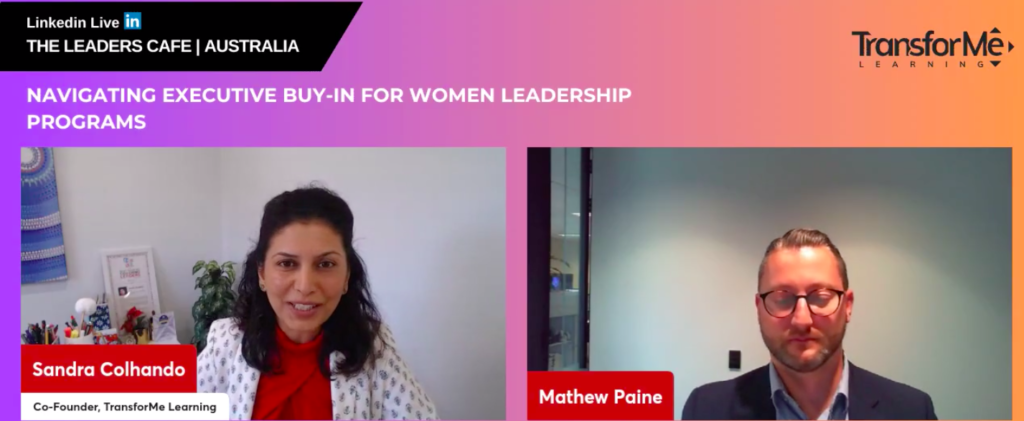
For our November 2023 edition of The Leaders’ Café, we had a special guest – Mathew Paine, a distinguished leader with over two decades of experience in human resources, organisational culture, and fostering women’s leadership. As the Executive General Manager – People & Culture at the Australian Financial Complaints Authority, Mathew is passionate about creating safe, inclusive, and productive workplaces where women can thrive and he shared some incredible insights on this topic with us.
Summary
- There are 3 key challenges for women with career progression – 1. Women have greater carrying responsibilities outside of work, therefore, it’s the woman who have to sacrifice their career for child-caring responsibilities 2. Women apply less frequently for roles than men 3 Women are more likely to doubt their skills and the chance of getting a role
- Every leader must ask – does our workforce represent the community that we serve? Australia, in particular, is a very diverse country. And if we don’t see the diversity inside the organisation, and we’re providing a service to the general population, something’s not right. So we need to start from a data-led approach to gender equity or DEI at large
- Mentorship and Sponsorship – Women are over-mentored, but they are under-sponsored, there are a lot of opportunities for women to upskill a key support that women leaders need today is to have somebody open the door, use the network and get them the position that they deserve
- Business case for Gender Equity beyond profitability – In 2024, the Workplace Gender Equality agency will be publicly publishing the gender pay gap of every organisation, not government, but all private organisations with more than 100 employees. And whilst there’s probably some, some of those organisations that do have only males at the top, and there could be females that are more junior levels that will just showcase even more the gap between the genders the pay gap between the genders. So there’s a real business benefit of making sure that organisations are, first of all measuring what the pay gap is, but then analysing their data and looking at what they can do because organisations are also going to be under stricter media scrutiny and need to be mindful of brand reputation risks they run
- With the economic slowdown and budget cuts, why organisations need to keep women leadership on their agenda – Reputation and Brand are crucial – they can have a huge impact on budgets, as well as turnover, lack of diversity and leadership can also lead to missed business opportunities. It could be a limited talent pooling or the brand and the reputation of the organisation. If it’s very male centric, that it may be that women just don’t want to go and work there. And that’s becoming more and more popular in Australia, where the employee makes a choice as to where they would like to work. And so they should, and if they’re not seeing the diversity or the ethics, or the values that they adhere to, personally, then they just won’t go there. So that’s going to have an impact also on profitability. Ultimately, shareholders, particularly for the public listed companies, they expect a shareholder expects to see not just that an organisation is producing results and profits. But more and more we’re seeing shareholders wanting to see the ethical components, as well are upheld by the boards and the CEOs of organisations.
FULL TRANSCRIPT
Sandra Colhando: Thank you, Matt. I want to start with your story. You hold the Chief People Officer domain, the role and there’s so much that comes under it from employee engagement, recruitment, and retention to performance, productivity, etc. Why is DEI so important for you?
Mathew Paine: For me, it really is about creating inclusive workplaces that then create a positive brand in the eyes of consumers and employees. Research shows that having a diverse pool of talent also brings about a variety of perspectives and that really helps to foster innovation, creativity, and ultimately boosting employee satisfaction and retention. And particularly in the HR world, a lot of the metrics that we use could be around satisfaction or engagement retention. And ultimately they also lead to no greater profits. And there are certainly shareholders and boards that are very interested in in seeing those metrics.
Sandra Colhando: Beautiful. And I know you’ve had this rich two decades of experience to actually see that happen. See that fruit refine in terms of results? When we look at some data points, for example, WGEA released a data set where they say that while women make up half of employees, about 51%, only 19% of CEOs of women, why do you feel is there a gap? Or what? What can be done to bridge this gap?
Mathew Paine: Yeah, it’s an interesting conundrum. I think if we step it up, and we think about from a global perspective, the World Economic Forum, every year brings out the Global Gender Gap index. And that benchmarks the current state, in the evolution of gender parity across a number of dimensions. And I just had a look at that this week. And for 2023, the number one country in the world out of 146, that they measure is Iceland, they’re doing a huge amount of work there. Australia is ranked number 26, which for a developed country, I would hope that it’s higher than that. And looking at India, it’s 127. So there are some huge gaps there. And if things keep going, they’ve been doing this for about 10 years. At speed, it’s going to take 131 years to bridge that gap. So there needs to be some quite drastic measures and initiatives put in place. And then if we think about more, Australia, in the UK, there is a gender pay gap in Australia of over 20%, about 22.8% To be specific, and men are twice as likely to be in the top income bracket as women and about boards. Only one in five boards have gender balance. So when I was when I was working in the New South Wales Government, there was a behavioural insights project that was completed around career progression of that was in conjunction with the Public Service Commission. The results found that there were four key challenges for women with career progression. And they were that women report that there’s more barriers to career progression. That women have greater caring responsibilities outside of work, therefore, it’s the woman that work or they have to sacrifice their career for child caring responsibilities, or also women apply less frequently for roles than men. And women are more likely to doubt their skills, and the chance of getting a role. Meaning a male may see a job and think, yeah, well look I am just here, but I’m going to apply anyway. Whereas a woman from this research that we conducted, was more likely to doubt their skills. So I think if you think about all that, together, there are probably a number of factors that still are at play. And we hear a lot about bias and stereotypes. There may be lack of representation also, of females in more senior roles in organisations; therefore, women may not envisage themselves to be in those roles. It could be that there is a workplace culture, or there’s practices in place that may lead to women not wanting to do those roles. For example, if there’s a really long working hours culture, if there is inflexibility of the work structure, maybe there’s no hybrid working or a lack of flexible working, all of those things can and those practices can really impact on the way women work. And then of course, things like unconscious bias when it comes to recruitment and promotion. There was a study recently actually in Australia, where it was for people and it’s not just women, but those that are working remotely. Could be overseen or over overlooked when it comes to promotions because they’re not in the office. And I think that there’s an overlay there. And then you know, other things like work life challenges. And in Maybe there’s even a lack of accountability inside organisations, you know, not holding CEOs or boards to account. So there’s probably a lot there. But that’s, that’s what I think.
Sandra Colhando: Beautiful. I am making notes and there seems a huge laundry list of why and what is the gap. I know there is work happening but in all of this, sometimes it just feels it’s so overwhelming. Where do we start? What’s the first step we take? With your experience and the background that you have- we are looking at recruitment, productivity, looking at culture, we’re looking at accountability, what will be the first step to take to start building this culture of gender equity?
Mathew Paine: Yeah, I think, like, where we need to start is thinking about the organisation, whatever organisation it is that that our listeners are working at. And I have always asked the question – does our workforce represent the community that we serve? Australia, in particular, is a very diverse country. And if we don’t see the diversity inside the organisation, and we’re providing a service to the general population, something’s not right. So we tend to start from a data-led approach. And it’s important to understand the matrix and how many, what is the gender breakdown, there might be some other diversity, and demographics that also organisations can measure and track, and then there’s the intersectionality of those two. So, you know, that may not be that it’s just male and female. But then if we add on other intersections, like cultural and linguistic diversity, could be an employee with a disability, could be that they identify as having a different sexual orientation. So there are many different factors. But I thiny understanding the data of your workforce is important. And that also really sets the the roadmap of where it is that you would like to go, and what’s the gap, and then thinking about some initiatives of how to bridge that gap. But I think if you don’t start with some type of a benchmark, it’s you need to know where you’re going. But you also need to know where you’re starting from.
Sandra Colhando: Absolutely, you’re connection is breaking up a little bit. So I’m just quickly summarizing – what you’re sharing is, you know, we need to look at where the organisation is, how’s the organisation representative of the clients or customers they’re serving. And how can we add in the sections and the diversity and work from there? I think what connected deeply with me when you’re, when you’re sharing this is setting the roadmap firs, before we jump into various initiatives, you want to see, what’s the road map for me as an organisation, which could be very different for another organisation at the same time. And what’s my way around it? And why do I need to have that included in our values? I think when you talk about the environment and culture of an organisation; it shouldn’t just be a tick in the box. It shouldn’t be just because it makes top-line sense that’s important for business, but it needs to go much deeper to create that sense of belongingness and organisation. And the decision-makers typically have that when you say the roadmap, are the executives, are people sitting at the board at the C suite level. That brings me to the question I know in an interview with HRM, you talked about selling diversity, and equity inclusion to the C-suite as one of the most significant challenges in this field. What do you think of what key elements should, say people cultural leaders need to include in the business case for women’s leadership programme to secure executive buy-in?
Mathew Paine: Good question, I think and you touch there about organisational values. So you know, really that there is alignment to values that there is an alignment to the organizational goals and emphasise how women leadership programs can align with the broader goals of the organisation, could be around improving innovation, diversity, and market competitiveness. And also the quantifiable benefits, there’s a lot of research out there that shows that a more diverse organisation has higher profits than those that are less diverse. But I think also it’s understanding the talent pipeline that you have internally, and helping to define what those success metrics are. Anthere are’s probably there’s pros and cons to setting targets. I’ve worked in organisations that have and have not, and I’m happy to talk about that. But I think, like I’ve mentioned before, you really need to know where it is that you’re going, as an organisation, and put it in, I think we can probably see the biggest change when we do have metrics that we put in place for the C suite, the executive team. And I’ve seen also where they might receive their bonus could be tied to those or their pay increases could be tied to particular metrics. And it’s not just financial, but also diversity metrics.
Sandra Colhando: That’s interesting. And you also talked aboutthe pros and cons of setting targets. So in your lived professional experience, what could be a target that is a pro that makes sense organisation because it drives positive culture in making this change? And what could be a target? That could be a con, which you need to be careful, about because it may not be a driving impact. It’s a target, we’re moving in that direction, but it’s not driving the right.
Mathew Paine: Yes. Okay, so I’ll give you an example, when I worked in the New South Wales Government, the Premier of the State had set targets, under particular diversity targets for all employers in the public sector. So we were working towards 50% women in senior leadership roles. And then there were some other metrics for other diversity initiatives. So I think the positive there was that there was a goal, everybody knew where we were going. And those targets were set up to 2025. So it wasn’t just an immediate overnight initiative, there were, you know, well-executed planned approaches to several initiatives. But where I’ve seen these initiatives or targets fall is where the Why isn’t explained properly. Those that don’t identify in those particular demographics, then they may go for a role and feel that they didn’t get the role because of their gender or because their diversity doesn’t align with that. So I think there needs to be, you know, real merit behind recruitment and selection. But sometimes, through initiatives, particular programs that work, they can certainly help to develop people. So an example that I worked with in government was we had a few different initiatives. One was the women in the senior leadership mentoring programme. It was a specific programme, only aimed at women who had high potential to move into a leadership role. And they were mentored by another executive who had already reached that goal, who was already working at that level. And it was a 12-month programme. And it was extremely popular. We always had so many people that wanted to be on it, because they saw that there were real tangible outcomes. And it wasn’t that they were favoured, but through their mentoring relationships and also the education that they received, It helped to shape them to then on, on their own merit when they went for a role that they felt comfortable and were able to achieve the selection criteria. And another programme that we ran was the Open Doors programme and which was a career sponsorship programme. So the difference between mentoring and sponsorship is mentoring is more about being available and assisting and helping to mentor and coach whereas the sponsorship programme was opening doors, but very soon new executives, who are then able to use their own connections, to then open doors and connections to those people who were then able to grow and to develop and to really benefit from that and leverage those executives, senior leadership roles. So we certainly had great success with both of those programmes. And we’re able to see some demonstrable outcomes.
Sandra Colhando: Oh, those are great programmes you talked about, we keep talking about this, there be maybe enough mentorship, maybe women are over-mentored, but they under-sponsored. So happy to hear you talk about the open-door programme, because there are a lot of opportunities for women to upskill. But I think the biggest support that women leaders need that is to have somebody open the door, use the network, and get them the position that they deserve. What about skill building? Matt, what do you feel? Do we need a separate programme for women leaders for them to skill belt to reach those positions?
Mathew Paine: Well, the success that we had with the women in the senior leadership programme was also that every couple of months, there would be a skills development programme aimed at that cohort of women that were on the programme. So I think there was some great marriage in that, where women were able to come along and discuss some of the issues that they may be facing and hear from other women about how they’re overcoming that or in the groups that they’ve been allocated with their trainer, that they can unpack that. And some of it could be, you know, purely down to their own confidence. And other things might be around skills. But I have seen that particular programmes aimed at women have had great outcomes. Having said that, I’ve also seen other programmes where it’s mixed genders, and there are also great outcomes. So I think it will probably depend on the content of those skills programmes, but I’m certainly not adverse to them.
Sandra Colhando: Yeah, often, we are asked why we need to have a separate women leadership programme and why not a mixed gender and you’re right, there is merit for both. But I also feel they’re very unique challenges that women professionals go through, which are listed out beautifully earlier in our talk, whether it’s you know, carrying responsibilities as a doubt imposter syndrome, which sometimes a uniquely hire for that gender, and therefore having a program exclusively to take care of those challenges, helps in managing and not creating a safe space for them to feel we are not in it alone there other women professionals going through this challenge and this asset community that’s created for us to move ahead. What I wanted to talk about, and you shared some very interesting initiatives that you’ve run, especially with the NSW Government in terms of targets. What can we do when maybe you don’t have an organisation that has a very strong executive mind for women leadership? Let’s take an example. An organisation is already profitable, and doing really well. But there is very little gender balance of the leadership in the leadership’s executive C suite, how do you showcase the return on investment on women’s leadership to them?
Mathew Paine: Yeah, it’s a good question. I think, particularly these days, we’re seeing more and more media for and not always positive, sometimes negative media, where there are organisations that don’t have good gender balance or don’t have good diversity, particularly as they go higher. And especially in Australia, for the next year 2024, the Workplace Gender Equality agency will be publicly publishing the gender pay gap of every organisation, not the government, but all private organisations with more than 100 employees. And whilst there are probably some, some of those organisations that do have only males at the top, and there could be females that are more junior levels that will just showcase even more the gap between the genders the pay gap, I should say between the genders. So there’s a real business benefit of making sure that organisations are, first of all measuring what the pay gap is, but then analysing their data and looking at what they can o, because I havy no doubt that from next year, there will be quite a few media articles that will come out that won’t be positive in a variety of different organisations in Australia. But I think also, then it just goes back to thinking about Australia in particular, as well, actually, no, not just Australia, but globally, there’s an ageing population. So women’s economic workforce participation is becoming more and more important around the world. The more women that are working, and particularly moving into more senior roles, the bigger the impact it is for the economy, that of the country that they’re in, the more tax they pay, those taxes then have benefits for the whole country. So there’s, there’s real equity, measures them. And outside of that, it’s just the right thing to do. So I think from an ethical perspective, organisations these days have got a lot of measures around ethics and sustainability, and gender balance, particularly in senior roles should be on everyone’s agenda.
Sandra Colhando: While we have this coming next year, which is working around the workplace gender balance, in today’s economic conditions, and with so-called economic slowdown, organisations now are holding on to the budgets. What’s your take on the future of women’s leadership landscape, in this environment, in this mind space?
Mathew Paine: Well, look, think about reputation and brand and that can have a huge impact on budgets, as well as turnover. And lack of diversity and leadership can also lead to missed business opportunities. I know, a lot of the consulting firms these days, when they go out, and they target business projects, they do all of this analysis before they then go off and select the organisation that they might want to work with. So there’s some potential of lost business there. It could be limited talent pooling or the brand and the reputation of the organisation. If it’s very male-centric, that it may be that women just don’t want to go and work there. And that’s becoming more and more popular in Australia, where the employee chooses as to where they would like to work. And so they should, and if they’re not seeing the diversity or the ethics, or the values that they adhere to, personally, then they just won’t go there. So that’s going to have an impact also on profitability. And, yeah, I mean, ultimately, shareholders, particularly for the publicly listed companies, expect a shareholder expects to see not just that an organisation is producing results and profits. But more and more we’re seeing shareholders wanting to see the ethical components, as well upheld by the boards and the CEOs of organisations.
Sandra Colhando: Yeah, it makes sense because you’re looking at a whole rounded organisation that not just looking at profits, but looking at the culture that’s creating in the future as well, was the thread if we just continue unidirectional? How do you get executive buy-in with data? Do you feel that the onus is only on say the chief people, learning and development departments to create that buy-in? Can anyone else in the organisation play a role and how can they create that noise with executives to make this happen?
Mathew Paine: Hmm, that’s a great question. Look, it shouldn’t be led just by HR or L&D. I mean, there’s organisational initiatives. And ideally, they should be sponsored at the executive level. So where I’ve seen the biggest impact in these areas is when an organisation decides to go down this track, and they might launch, for example, a diversity, inclusion, and belonging strategy. And within that, there might be multiple silos or segments of diversity that they would like to work on. So there could be, for example, demographics of women in senior leadership, which is the topic for today, it could be people with disability, it might be LGBTQIA+ inclusion, could be other things. But then, it’s not just about having a plan on a page, it’s about bringing it to life, I would suggest that there are executive sponsors for each of those. And then within that, it’s also brought to life through the employees, what we call an employee resource group. So for example, there could be a shared agenda, a women’s employee resource group, there might be people with disability, and there could be other cohorts that those groups get together. And it’s not just about social connection, but it’s also thinking about from an organisational perspective, what can they do better? What’s their feedback? Are there policies or procedures that are getting in the way of workforce participation? Are there things that are a handler to, to the workforce? What are the other metrics, if the organisation is doing surveys, what’s the feedback from those groups being able to break down survey responses by demographic So ideally, I would see that there is executive sponsorship, employee resource groups, and an action plan that is regularly communicated back out to the organisation, and that the CEO is involved, or the most senior person in the organisation is involved in that as well.
Sandra Colhando: When you share this, is that there’s a story that came up for me when you talked about employee resource groups, especially women. And this happened around COVID, when you know, budgets were shut down organisations were not getting into investment mode. So there’s a client of ours and their organisation was severely hit by the COVID shutdown leading to budget cuts. But there was a women’s resource group that got together. So the women professionals just got together in the organisation and they decided to drive the agenda, they would fix these meetings, they would actually reach out to industry leaders, facilitators, coaches and create this once-a-month forum where they’ll invite a coach on a special topic, and they ran a program with zero budgets. Yeah, so that’s a great example of when you talked about women’s resource group, how they can gather resources and get that done. Hmm,
Mathew Paine: Yeah, totally. And I’ve seen that those grassroots initiatives where it’s not actually led by the organisation that’s led by the members of the group can sometimes have even greater impact.
AUDIENCE QUESTIONS
Sandra Colhando: I’m seeing our questions here. So I’m going to jump right into the question especially there’s a question that resonates with the one that I had for you. Can you share a comparative view of how the public sector and private sector varies in gender representation in Australia? I think one of the past speakers mentioned that the public sector needs to up its game and has things to learn from some positive initiatives undertaken by corporate sector. Your thoughts, please?
Mathew Paine: Good question. I guess first of all, I don’t have the data right in front of me, so I wouldn’t be able to answer exactly the specifics. But what can what I can say is there were a few initiatives that were run in Australia that really helped to increase participation, particularly women in the private sector. And that was the male Champions of Change programme, which you may have heard of, and that programme really was a call out to male, particularly male sponsors and male CEOs. And looking at how they can make organisational change, that would then lead to greater female representation and the view through that initiative, which is still going. And maybe it’s not as popular as at what it was, but certainly still going, there was a very large increase of women participation, but equally in the public sector, which is where I also had experience, particularly New South Wales, when the premier set targets for 50% women in senior leadership, it really helped myself particularly as a chief people officer and in the role that I was in the executive director role also that I held, to be able to hold leaders to accountable and to say, every month, we would measure where we’re, we’re able to look at the gap, we’re able to then come up with some really meaningful programmes and regularly report that data, and how we’re increasing that data to the executive team through a monthly pack of data and metrics. And that visibility at the senior level really helps everyone to have buy-in. And, you know, I think it makes in some cases, it might make it easier when you’ve got you’ve got that real push, particularly when we’re getting close to achieving that. So I think in the end, where you’ve got leaders, most leaders, particularly doesn’t matter what industry, private or public would want to achieve targets. So there’s that old saying what gets measured gets done or variations of it. But I think that that helps.
Sandra Colhando: That’s a brilliant example of how you get executive buy-in, because you have a target come from an executive or come from the top, and you actually measure it and continue in that direction. Yeah, and what gets measured gets seen as well.
Mathew Paine: There is probably one more thing on that topic. It was important for us as well to really highlight and demonstrate particular days of significance in the calendar year. So International Women’s Day is one that comes to mind. And on International Women’s Day, every year, we would hold an event, it was for all genders, not just women, but we would highlight and we’d have normally a panel of female leaders, successful female leaders that would talk about their leadership journey, their struggles in how it is that they might be able to juggle work with family, and any other things that they might want to talk about and really showcase their story. Because then other female leaders and other females can aspire and learn from those. So having those real-life stories and bringing those days of significance to life, I I find that helps a lot.
Sandra Colhando: Absolutely. I’m going to go to the next question – What role do emerging women leaders play in achieving gender diversity?
Mathew Paine: I think that everyone has a part to play in this and those that have succeeded and got already achieved those female leadership roles. They should also be helping the pipeline or talent behind them. Because and I see this and it’s not just in female leadership, but all levels of diversity. That if everyone helps to pave that, that journey forward, it’s going to make it easier and more acceptable for those who are still aspiring to go through that journey. So for them to be able to use their experience, maybe talk about what worked well for them, and what didn’t work well. Being a mentor, and being available to coach other people that might want to aspire. Everyone has a part to play and and hopefully they can use their own experience to help others.
Sandra Colhando: Yeah, I think that’s linked to the next question. From your experience, Matthew, what us some of the top three skills that were in professionals can build or work towards to becoming a strong contender, contender for the top positions?
Mathew Paine: Oh, that’s a hard one. There are so many amazing skills that are out there. Look, I always say to anybody, if they would like to move up the ladder, it’s thinking about their curiosity, their innovation, but also, going for a more senior role is not just about technical skills. It’s about people leadership, and it’s about relationships, negotiation, it’s about how to navigate difficult decisions. So it’s, you know, focusing on what’s probably traditionally called maybe those softer skills. Because it’s not just about the hard skill of doing your job leaders have to be able to really have that emotional intelligence to be able to deal with many different scenarios. So having that that level of, of skill is important. But I think look, it probably also depends on the role that they’re going for, but certainly people leadership, I’d be looking if someone’s going for a leadership position, ideally, that they’ve done some type of other mentoring coaching or leadership, it could be an in an external voluntary role, or it might be something else.
Sandra Colhando: Yeah, I was looking at when you talked about E, I am looking at E IA, it is having emotional intelligence and action. Sometimes we have emotional intelligence, we know what’s happening, but the action gets missed. And that’s where true change comes. And that’s why we drive that change is still an experiment, failures, shouldn’t be a roadblock. But just to try more aspects, more doors, one door closes, how do we open the next door? Yeah,
Mathew Paine: That’s right. You mentioned before about imposter syndrome. And I think like, that’s common for many people. In that they may not, they may not think of themselves as the best person for the role that they’ve got to the role and that they’re doubting their own skills and experience. And I think it is normal. But having, not letting it become so debilitating, that you can’t actually then perform in the role and action.
Sandra Colhando: in this section, I do want to share my own personal take on impostor syndrome, because I had a lot of impostor syndrome. There are many opportunities, I didn’t raise my hand, early in my career, and I missed many opportunities. They’re, they’re funny stories now. But they weren’t that time, and I missed it. But this is what I tell myself to overcome impostor syndrome is saying that there is no rule ever, I’d be perfect for, especially in this uncertain environment, that we are working and then uncertain world that we are in, we will never be perfect in any role, because you don’t have control of what happens externally. So knowing that and then jumping into that situation, raising your hand for that opportunity is the best thing you can do for yourself and for the road that you take. And that’s my little tip on how I overcame it. Before we wrap up, we have a minute to go. I’m going to take up the last question – Are there unique considerations or challenges in gaining executive buy-in from leadership in a global context? And how can these be addressed?
Mathew Paine: Hmm, yeah, that’s a it’s a deep question. And I think definitely, in a global context, there are unique circumstances and that would come down to the cultural have elements of that country. If I talk about it, from my experience in the Western world, certainly in Australia, I’ve worked in roles that also cover New Zealand and the UK or worked in London for eight years. I think these days, it’s definitely more and more accepted. And it’s not just accepted, it’s actually expected that organisations have that cultural and gender diversity. But having said that, there’s there’s countries that are still out there in the world that have got a long way to go. So, you know, I can’t probably comment so much about those countries. But, you know, certainly being able to focus on the ones and the initiatives that work is something that I would focus in, probably just express that. Yes, in some countries, there’s a long way to go. But I’m hoping that, you know, what, take that 131 years that what I mentioned at the start with the World Economic Forum data.
Sandra Colhando: Yeah, I believe that’s a good start point. And what you shared so far, and, of course, it’s a call for action in any country talk about results, you talk about innovation, creativity, bias, etc. It’s common, but I think the cultural aspect if we have storytelling that’s associated with it, which is unique to your culture, showcasing those stories, this case studies, I think that creates that uniqueness in each culture. Thank you, Matt, for these rich insights for our team. And thank you, everyone who’s been listening and we’ll be seeing the recording as well. Thank you for your questions. Thank you for being there. We’ll be back next month for another interesting topic. Get ready for the holidays and enjoy the next few weeks. Thank you everyone.
Mathew Paine: Thank you. Thanks, Sandra. Thanks, everybody.
This article is written by our colleague and Co-Founder, TransforMe Learning, Sandra Colhando as an official member of Forbes Coaches Council. Read the full article here.
The ability to engage, influence and inspire people is crucial, and storytelling can be your ally.
An experiment about “the identifiable victim effect” was conducted at Carnegie Mellon University in 2007 to explore the difference between a fact-based approach and a story-based approach in influencing people. The study showed that students who received a fact-based appeal from Save the Children donated $1.14, whereas students who read a story about a specific child donated an average of $2.38, more than twice as much.
Additionally, if you watch this TED talk by Hans Rosling, you will see how a topic as data-heavy as 60 years of world health data can be made engaging and engrossing through storytelling.
The message is clear: Storytelling can help build your credibility, initiate change, inspire teams and engage people.
Here are four tips that you can leverage to become a great storyteller.
Tip 1: Telling The Right Story
In my opinion, telling the right story is about two things: knowing your objective and ensuring audience relevance. Let me explain how that works.
Is your goal to introduce yourself? Or do you need to influence someone? Or are you trying to foster collaboration? Knowing your objective will help you be clear on whose story you are sharing. If you’re introducing yourself, the story must be about you—your experiences, your journey. A classic story structure for this goal is “the hero’s journey,” which Joseph Campbell describes in his book The Hero with a Thousand Faces.
But if you’re trying to influence someone, the story might be about someone similar to your audience, who went through a similar problem or situation and overcame it. Let’s say you want to influence your team to innovate and stay ahead of the curve. You might share the story of Nokia or Blackberry or even Kodak—organizations that struggled to stay ahead of the curve and how it impacted them. This story will be relatable and relevant because your audience will be able to draw connections between their situation and the situation these organizations were in.
Once you have a pattern, it’s about crafting the journey. Regardless of the pattern, each story must have a protagonist, a dilemma/problem to solve, a resolution and an outcome/learning.
So it’s not just about telling a story; it’s about telling the right story.
Tip 2: Stories Of Personal Failure
The reality is that since we were kids, we have been told that failure and mistakes are signs of weakness.
Many leaders attempt to inspire people by sharing stories of past successes—but countless examples show us that stories of failure can inspire people, too.
Take for example J.K. Rowling’s 2008 Harvard commencement speech, where she inspires the graduates through her story of failure. Here’s an oft-quoted excerpt from this speech that illustrates the power of a well-chosen personal anecdote: “…by any conventional measure, a mere seven years after my graduation day, I had failed on an epic scale. An exceptionally short-lived marriage had imploded, and I was jobless, a lone parent, and as poor as it is possible to be in modern Britain, without being homeless. The fears that my parents had had for me, and that I had had for myself, had both come to pass, and by every usual standard, I was the biggest failure I knew.”
In my opinion, stories of failure can have a much deeper and more powerful impact on inspiring people than success stories because people relate to failure and it invokes deeper emotions like empathy, compelling them to take action.
Tip 3: The Stories We Tell Ourselves
One of the opening statements in my own company’s storytelling workshops is: “The stories you tell yourself stop you from telling the stories you must!”
You could have the most amazing story, but you may hesitate to share it. Internal stories like “Why would anyone want to hear my story?” or “What if people don’t like it?” are big obstacles for many of us. Psychologists refer to these feelings as a “fear of negative evaluation” (FNE), which they’ve quantified through an assessment they also call FNE. A high score on this scale is more likely to lead an individual to perceive their attempt at public speaking, for instance, as poor.
Replacing hindering internal stories with positive ones can transform and influence your external storytelling.
Here is a quick exercise I use in my courses to help change a harmful internal narrative: Ask yourself to think of a situation where you felt you were being negatively judged but later realized it was all in your head. As you think of this incident, “amplify” the feeling of relief you felt when you figured out that your perception of the situation was worse than it actually was. There you go—you are beginning to change the story you tell yourself!
Tip 4: The Art Of Starting
How you begin a story matters. Let me share three sure-fire ways my company has developed to help you get your audience hooked from the first sentence you say:
• Intrigue: You don’t always have to start the story from the beginning; instead try starting from the most impactful, emotional or compelling part of your story, and then go back to the beginning. This will keep your audience truly intrigued.
• Question: The most powerful thing a question does is compel your audience to think. So ask a rhetorical question, pause for a few seconds and then answer it yourself!
• Visuals: Another great way to start a story is to show an image and use that as the foundation for your narrative.
Conclusion
In the world of business, storytelling is more than a skill; it’s a superpower. By applying these four secrets, you can not only engage, inspire and influence but also establish yourself as a thought leader in the art of storytelling.
Would you like to know more about how your organisation can leverage Storytelling for business success? Read more about our Storytelling module.
Write to us to at connect@transformelearning.com to elevate your storytelling game.